Let's talk about strength - the acquisition thereof. A highly personal journey for any human being, but with some universal truisms which should be noted for posterity.
As a scientist, indeed a data scientist, I realise the power of the normal distribution. We are, most of us, average - more or less. A very tiny proportion of human beings occupy either the stratified air of elite athleticism and genetic ability, or the gutter of physical ineptitude. Despite this, most of us label ourselves as either gifted or more likely inept when physical exercise and strength training are concerned. The 'Hardgainer' phenomenon is still in vogue, trying to rob us of the neccessary self-belief to get under a heavy barbell, squat down, and stand back up again.
In the belief that my ongoing journey to strength is typical of most human beings (although I am a slightly larger human being than average), I have decided to start this blog to comb through my training journals. Hopefully the exercise will prove useful for this human being as well as others.
Let's start with some numbers to place ourselves on the map.
I have been strength training since June 2013, coming on 4 years.
As a scientist, indeed a data scientist, I realise the power of the normal distribution. We are, most of us, average - more or less. A very tiny proportion of human beings occupy either the stratified air of elite athleticism and genetic ability, or the gutter of physical ineptitude. Despite this, most of us label ourselves as either gifted or more likely inept when physical exercise and strength training are concerned. The 'Hardgainer' phenomenon is still in vogue, trying to rob us of the neccessary self-belief to get under a heavy barbell, squat down, and stand back up again.
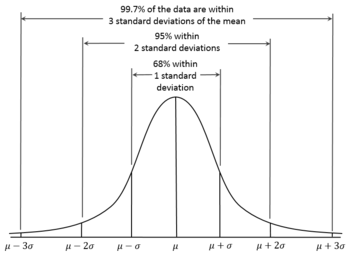 |
| "Hardgainers" would occupy the extreme left - i.e. there are very few |
In the belief that my ongoing journey to strength is typical of most human beings (although I am a slightly larger human being than average), I have decided to start this blog to comb through my training journals. Hopefully the exercise will prove useful for this human being as well as others.
Let's start with some numbers to place ourselves on the map.
I have been strength training since June 2013, coming on 4 years.
My best lifts to
date are:
-
Squat 5 x 190Kg (419lbs)
-
Deadlift 5 x 200Kg (441lbs)
-
Bench 5 x 115Kg (254lbs)
-
Overhead Press 5 x 80Kg (176lbs)
Not particularly strong, but getting there.
For fun, we can use
the AllThingsGym repmax calculator to have a look at what my 1RMs
might be:
-
Squat: 219kg (483lbs)
-
Deadlift: 231kg (509lbs)
-
Bench: 133kgs (293lbs)
-
OHP: 92kgs (203lbs)
1RM calculators are notoriously inaccurate, and I could spend a couple of paragraphs tearing down these numbers - but let's not.
My beginnings are perhaps not entirely typical - I actually used a well thought out and extremely effective program for my first months of training. I started out, like many others, following Mark Rippetoe’s starting strength program for novices.
Initially this was just me following a program google had thrown up, but I soon got the book and used it to successfully teach myself good squat technique and reasonable technique on the other barbell lifts.
I did what I was told, sets of five and eating like a machine. My weight went from 92kg (203lbs) to 106kg (234lbs) and my last day of squats on starting strength was 3 sets of 5 at 162.5kgs (358lbs).
Looking back, mistakes were made. Like many who truly commit to the starting strength linear progression, my squat strength went through the roof while the other lifts plodded along. Not knowing any better I stayed on the linear progression long after it had ceased to produce results, meaning I was working ridiculously hard for mediocre results.
My beginnings are perhaps not entirely typical - I actually used a well thought out and extremely effective program for my first months of training. I started out, like many others, following Mark Rippetoe’s starting strength program for novices.
Initially this was just me following a program google had thrown up, but I soon got the book and used it to successfully teach myself good squat technique and reasonable technique on the other barbell lifts.
I did what I was told, sets of five and eating like a machine. My weight went from 92kg (203lbs) to 106kg (234lbs) and my last day of squats on starting strength was 3 sets of 5 at 162.5kgs (358lbs).
Looking back, mistakes were made. Like many who truly commit to the starting strength linear progression, my squat strength went through the roof while the other lifts plodded along. Not knowing any better I stayed on the linear progression long after it had ceased to produce results, meaning I was working ridiculously hard for mediocre results.
I followed the starting strength linear progression with 5/3/1. Out of the frying pan and into the lukewarm bubble bath.
I was so completely exhausted at the end of my linear progression that I just couldn’t face into the texas method, a common follow on to starting strength for the now intermediate level lifter. Progress on 5/3/1 was reasonable, though more so for squats and deadlifts than for the presses. At the time though, having enjoyed huge gains on starting strength, I was a little disappointed and moved on after about 8 cycles.
There followed a period of disillusion - or rather disinterest. It takes a huge amount of motivation to work hard enough in the gym as an intermediate strength trainee to get results. In the beginning the results themselves provide motivation, but later this needs to come from somewhere else.
I was so completely exhausted at the end of my linear progression that I just couldn’t face into the texas method, a common follow on to starting strength for the now intermediate level lifter. Progress on 5/3/1 was reasonable, though more so for squats and deadlifts than for the presses. At the time though, having enjoyed huge gains on starting strength, I was a little disappointed and moved on after about 8 cycles.
There followed a period of disillusion - or rather disinterest. It takes a huge amount of motivation to work hard enough in the gym as an intermediate strength trainee to get results. In the beginning the results themselves provide motivation, but later this needs to come from somewhere else.
I decided to start competing as a way to add
some motivation to my training. Rather than go down the obvious route of
powerlifting, I chose to take up throwing.
I can't honestly say exactly why - perhaps I saw it as a first step towards a long held interest in taking part in the Highland games. It doesn't matter now though, I began throwing in late 2015, and it’s become a huge part of my life.
I can't honestly say exactly why - perhaps I saw it as a first step towards a long held interest in taking part in the Highland games. It doesn't matter now though, I began throwing in late 2015, and it’s become a huge part of my life.
Around the time I
started throwing I wrote myself a simple Heavy-Light-Medium
program which I aimed to follow through from August to Christmas
2015. The other Rippetoe book "Practical Programming" provided me with the tools I needed to do this, and indeed I still refer to it on a weekly basis to keep my programming on track.
This marked the beginning of a move back to progress in all of my lifts, which continues to today.
This marked the beginning of a move back to progress in all of my lifts, which continues to today.
Now with a best of
13.18m (43.3 ft) in the shot put, I compete regularly in the season
and have placed as high as sixth in my state championships. I have
made friends in the sport, found a great coach (eventually), and
found something I can really sink my teeth into.
 |
| Victorian Championships 2017 |
Despite occasionally
taking away from my ability to train hard in the gym, my trajectory on
the lifts has been largely upward since beginning my throwing
career. I now know that competing as an athlete is, for me, essential to maximising my potential in strength.
In the next few
posts I will look back through my training logs and try to
characterise the various periods involved. I’ll try to see what
mistakes were made and how they could have been avoided.
See you soon.

Comments
Post a Comment